Key Takeaways
- Freelancer fits small, clearly scoped jobs done by one person, and usually costs 20% to 50% less than an agency.
- Agency fits business-critical, multi-skilled, or long-running sites, because a team removes the single point of failure a lone freelancer creates.
- A basic WordPress site runs about $500 to $2,000 with a freelancer and $2,000 to $4,000 with an agency; a WooCommerce store runs $5,000 to $10,000 versus $8,000 to $25,000 (Flexiple).
- Freelance WordPress rates commonly land between $50 and $150 per hour, depending on experience and platform.
- Reliability matters: only about a third of projects finish on time, on budget, and on scope, and a solo developer has no backup if they get sick or disappear.
- A poorly built site is the real cost. A one-second delay in load time can cut conversions sharply, and the average US data breach hit $10.22 million in 2025.
Hire a freelance WordPress developer when your project is small, well-defined, and one skilled person can finish it. Hire a web development agency when the site is business critical, needs several skills at once, or has to keep running long after launch. Freelancers usually cost 20% to 50% less up front. Agencies cost more but spread the work across a team, which lowers the risk of a stalled project or a site nobody can support next year.
That is the short answer. The harder part is knowing which situation you are actually in, because the wrong choice is expensive in ways that do not show up on the first invoice. This guide walks through real 2026 costs, the reliability data behind each option, and a simple framework you can use to decide in a few minutes.
WordPress still runs a huge share of the web, so this is a decision millions of owners face. As of July 2026, WordPress powers 41.5% of all websites and 59.2% of every site built on a known content management system. A platform that big has a deep talent pool on both sides, which is good news and also why the choice feels confusing.
What Is the Real Difference between Web Development Agency vs Freelance WordPress Developer?
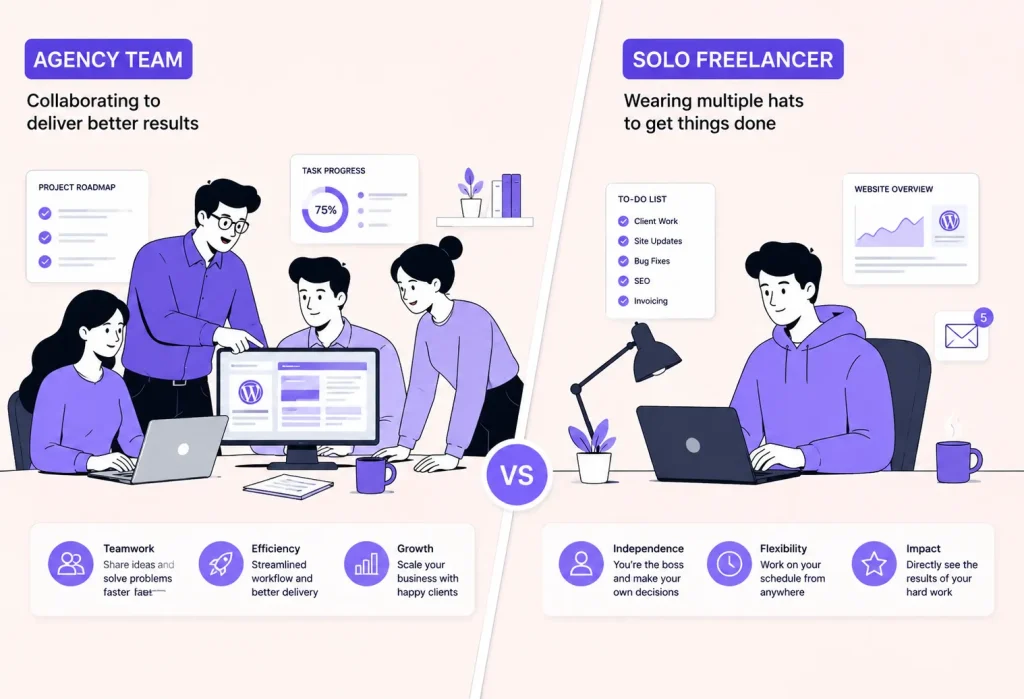
A freelance WordPress developer is one person you hire directly. They often handle several skills at a decent level: theme work, plugin setup, some design, and basic SEO. You talk to them, they do the work, you pay them. When they are good, it is fast and personal.
A web development agency is a company with a team behind it. A single project might touch a designer, a developer, a project manager, an SEO specialist, and a QA person. You usually talk to one contact, but several people share the work. When it is set up well, no single absence stops the project.
The gap that matters is not skill. Plenty of freelancers are more skilled than the average agency developer. The gap is coverage and continuity. A freelancer is one calendar and one skill set. An agency is a group, a process, and a backup plan. Everything below comes back to that difference.
The market reflects how valuable it is to get web development right. According to Mordor Intelligence, the global web development market was valued at USD 80.6 billion in 2025 and is projected to reach USD 87.75 billion in 2026, growing at a CAGR of 8.87% to USD 134.17 billion by 2031. Demand is growing on both the freelance and agency sides, so you have a real choice in either direction.
A freelance WordPress developer is one person hired directly, while a web development agency is a team that shares the work across specialists. WordPress powers 41.5% of all websites, and the wider web development market reached about $80.6 billion in 2025, so skilled help is available on both sides. The deciding factor is coverage and continuity, not raw skill.
How Much Does Each One Cost in 2026?
Price is usually the first question, so start here, but read past the headline number. A freelancer almost always wins on the first invoice. Whether they win on total cost depends on how the project goes.
Hourly rates
Freelance WordPress rates vary widely by experience and where you hire. Pre-vetted WordPress specialists on Codeable typically charge $80 to $120 per hour. On open marketplaces, a mid-level developer averages around $73 per hour and a senior around $128, with the full range running from roughly $25 to $275. Broadly, expect $50 to $150 per hour for a competent freelancer, and treat rates well below that as a warning sign, not a bargain.
Agencies bill higher per hour because that rate covers a team and overhead, not one person. Agencies commonly add a 30% to 50% premium over an equivalent freelancer, and freelancers usually come in 20% to 40% cheaper on the same brief.
WordPress Developer Hourly Rates, 2026 (Sources: goLance, Codeable, Elementor)
| Channel | Typical hourly rate |
| Marketplace mid-level | ~$73 |
| Senior freelancer | ~$128 |
| Codeable specialist | $80-120 |
| Agency | $150+ |
Project cost by site type
Whole project pricing tells a clearer story than hourly rates, because it captures the scope. Here is a typical 2026 spread.
| Project type | Freelancer | Agency |
| Basic 5-page site | $500 - $2,000 | $2,000 - $4,000 |
| Custom business site | $2,000 - $5,000 | $5,000 - $10,000 |
| WooCommerce store | $5,000 - $10,000 | $8,000 - $25,000 |
The pattern is consistent. On simple sites, the price gap is small, so a good freelancer is often the sensible pick. On complex or revenue-generating sites, the gap grows, and so does the value of the extra people the agency price buys you.
When Is a Freelance WordPress Developer the Right Choice?
A freelancer is the better call more often than agencies like to admit. Pick a freelancer when most of these are true:
- The scope is small and clear. A five-page brochure site, a landing page, a plugin fix, or a specific feature. Work that one person can hold in their head.
- Budget is tight and the site is not yet mission-critical. Early-stage businesses often need something live and decent, not perfect.
- You want direct contact. No project manager in the middle, no ticket queue. You message the person doing the work.
- You need one narrow skill. A speed tune-up, a bug hunt, a custom Gutenberg block. Specialists on the freelance market go deep into single problems.
- You can manage the project yourself. You are comfortable writing the brief, checking the work, and filling gaps the freelancer does not cover.
In our experience auditing hundreds of small WordPress sites, most of the healthiest ones were built by a single competent freelancer, not an agency. For a simple site, one focused person who cares is hard to beat. The trouble almost never starts at build time. It starts a year later, when that freelancer has moved on and nobody left knows how the site was put together.
That is the freelancer’s real weak spot, and it is worth naming plainly. One person is one calendar. If they get sick, take a big client, or simply stop replying, your project stalls with no backup. On a small job that is a manageable risk. On a site your revenue depends on, it is the thing that keeps owners up at night.
When Does a Web Development Agency Win?
An agency earns its higher price when the cost of something going wrong is high. Choose an agency when most of these are true:
- The site is business critical. It drives leads or sales, and downtime costs real money. You need people on call, not one person’s goodwill.
- The work needs several skills at once. Design, development, SEO, copy, and QA on one timeline. One freelancer cannot be five specialists.
- The project is large or complex. A custom store, a membership platform, a multilingual site, or a migration with a lot of moving parts.
- It has to keep running for years. Someone needs to own security updates, backups, and performance long after launch. This is where a team beats a solo builder decisively.
- You do not want to manage it. You want to hand off the problem and get a working result, not run the project yourself.
Continuity is the core of the argument. Delivery data across the industry shows how often projects go sideways: only about a third finish on time, on budget, and on scope. A team with a process and a project manager is built to catch the problems that derail solo work: scope creep, missed handoffs, and the developer who vanishes mid-build.
The scaling case is just as real. When traffic climbs or the business grows, someone has to keep the site fast and stable under load. That is a team job, and it is exactly the kind of work our guide to building a scalable WordPress site breaks down. A freelancer can build for scale, but keeping a busy site healthy month after month needs more than one calendar.
What Does the Wrong Choice Actually Cost?
The price on the quote is not the real cost. The real cost is what a poorly built or unsupported site does to the business over the next year. Two numbers make the point.
Speed. A slow site quietly loses sales every day. Site speed research shows conversions drop steeply as load time rises, and even a one-second delay can cut conversion rates hard. If a cheaper build ships a bloated, slow site, the lost revenue can dwarf the money saved on the quote within months.
Security. WordPress is the most targeted platform on the web precisely because it runs 41.5% of all sites. When a build cuts corners on updates, backups, and hardening, the downside is severe. The global average data breach cost was $4.44 million in 2025, and in the US, it reached an all-time high of $10.22 million. Most small business sites will never face a seven-figure breach, but the direction of the risk is clear, and cleanup after a hack is never cheap.
[Our Insight] The most expensive websites we see are not the ones that cost the most to build. They are the cheap ones that were built once, by someone now unreachable, with no documentation, no backups, and no one responsible for updates. The bill arrives later as an emergency rebuild. When you compare an agency quote to a freelancer quote, you are not just comparing build price. You are comparing who is still answering the phone in eighteen months.
This is also the honest reason to consider ongoing support rather than a one-time build. Whoever you hire, a site needs updates, backups, and monitoring to stay healthy. If you want a second opinion on an existing site before you decide, a WordPress site audit will show you exactly where it stands today.
How Do You Decide? A Simple Framework
Skip the pros and cons lists and answer four questions honestly. They sort most owners quickly.
- How much does downtime cost you? If a day offline barely matters, a freelancer is fine. If a day offline costs real money, you need a team on call. Lean agency.
- How many skills does the job need? One skill, one calendar, freelancer. Design plus development plus SEO plus ongoing care, agency.
- Who maintains it in a year? If you have an answer other than “not sure,” a freelancer can work. If nobody owns the site after launch, an agency or an ongoing support plan protects you.
- Can you run the project? If you can write the brief, review the work, and manage the timeline, a freelancer saves money. If you want to hand it off, an agency is what you are paying for.
A useful middle path exists, too. Many owners hire a freelancer for the initial build, then move to an agency or a support plan for maintenance once the site matters to the business. You get the freelancer’s price on the build and a team’s coverage where the long-term risk actually lives.
For a business that expects its site to grow and stay reliable, that is often the pattern to plan for from the start. Our WordPress development work is built around exactly this: a site that launches clean and stays supported, so the cheap year one decision does not become the expensive year two problem.
Frequently Asked Questions
Is a freelancer or an agency cheaper for a WordPress site?
A freelancer is almost always cheaper up front, usually by 20% to 50% on the same brief. A basic site runs about $500 to $2,000 with a freelancer versus $2,000 to $4,000 with an agency. Total cost can flip if a cheaper build needs fixing later, so weigh the risk, not just the quote.
How much does a freelance WordPress developer charge per hour in 2026?
Expect roughly $50 to $150 per hour for a competent freelancer. Pre-vetted specialists on Codeable charge $80 to $120, while open marketplace rates run from around $25 to $275, depending on experience. Treat rates far below the range as a warning sign.
Which is better for a WordPress ecommerce store?
Usually an agency. A WooCommerce store touches design, payments, security, performance, and ongoing maintenance at once, which is a team job. Store builds run about $5,000 to $10,000 with a freelancer and $8,000 to $25,000 with an agency. The higher price buys coverage on a site where downtime directly loses sales.
Can I start with a freelancer and switch to an agency later?
Yes, and many owners do. A common pattern is a freelancer for the initial build, then an agency or support plan for maintenance once the site becomes business-critical. You get the lower build price and a team’s coverage for the long-term risk, which is where most site problems actually appear.
What is the biggest risk of hiring a freelancer?
Continuity. A freelancer is one person with no backup. If they get sick, take on a bigger client, or stop responding, your project stalls, and there is no one else who knows the work. On a small, finished job, the risk is minor. On a live, revenue-generating site with no documentation, it is the most common way a cheap build turns expensive.
The Bottom Line
There is no universal winner, and any agency that tells you otherwise is selling. Match the hire to the job. Small, clear, and self managed points to a freelancer. Business critical, multi skill, or long running points to an agency. When you are unsure, ask what a stalled project or an unsupported site would actually cost you, then hire the option that makes that risk small enough to sleep on.